

The hybrid advantage: Why the future of trade mark law is AI and human
How will legal-grade AI and human expertise combine to transform trade mark clearance, risk management and brand protection in an increasingly complex global landscape?
The trade mark profession is entering a defining decade.
Global trade mark activity continues to evolve in scale and complexity, and technological advances are reshaping long-established workflows. In this environment, the most effective trade mark teams are not those seeking to automate away expertise, but those that amplify professional judgement with advanced intelligence.
This hybrid approach, combining human insight with legal-grade artificial intelligence, is emerging as the foundation of future-fit trade mark practice.
A rapidly expanding global trade mark environment
Trade mark filing and registration activity remains extensive and resilient, reflecting the enduring importance of brands in a competitive global economy. According to the World Intellectual Property Organization (WIPO), the stock of active trade mark registrations worldwide expanded by more than 6% in 2024, reaching an estimated 93.2 million active trade marks across the globe. This growth reflects sustained renewal activity and ongoing demand for brand protection across industries and jurisdictions.
In the same year, an estimated 8.3 million trade mark registrations were recorded globally, representing a significant increase in new registrations following a period of decline. These figures illustrate that brand protection remains a strategic priority for businesses, even amid fluctuating economic conditions.
The sheer scale of trade mark activity underscores the intensity of naming congestion and risk exposure that trade mark professionals must manage today. With more than 100 million active marks forecast globally in the near term by industry analysts and data providers, and generative AI accelerating brand creation, clearance is no longer a static, early-phase task but a continuous, dynamic risk function embedded throughout the brand lifecycle.
Clarifying the role of AI in trade mark workflows
In discussions about artificial intelligence and trade mark work, it is vital to distinguish between generic AI tools and legal-grade AI. Tools designed primarily for content creation or broad language understanding are not the same as systems engineered to support rigorous legal decision-making.
This shift is reflected in how legal teams are allocating resources. Corsearch’s ‘State of Trademarks’ research, based on an independent global survey of trade mark practitioners, shows that 63% of legal teams now allocate the largest portion of their trade mark budget to clearance and search, reinforcing its role as a strategic decision point rather than a procedural formality.
The real value of AI in trade mark practice is not simply faster search results. Rather, it lies in transforming how risk is analysed and surfaced. Effective AI for trade mark work must:
- Understand jurisdictional nuance, including national and regional differences in examination and enforcement.
- Provide explainable reasoning, enabling professionals to justify decisions with transparent logic.
- Prioritise risk relevance, rather than volume of similarity results.
- Integrate across workflows, so that screening, search, watching and management are cohesive and connected.
Without these capabilities, AI can generate noise that consumes time rather than enabling better decisions. Practitioners need insight that enriches their legal judgement, not output that obscures it.
From speed tools to risk intelligence
Next-generation trade mark AI is evolving beyond basic pattern matching and rapid result generation. It is increasingly focused on risk intelligence - the ability to translate large volumes of data into prioritised, contextually meaningful insights that support strategic decisions.
Where traditional search might highlight every possible match regardless of relevance, modern systems evaluate similarity through multiple dimensions. These include phonetic, semantic, and visual analysis, as well as contextual factors such as jurisdiction, goods and services overlap, and real-world enforcement history.
This transition has profound implications for practitioners. Instead of asking whether there are any matches, the critical question becomes: which of those matches truly matter from a legal and commercial perspective? In a landscape where millions of marks exist, the ability to focus on material risk is essential.
The enduring role of human expertise
Despite significant advances in computational intelligence, trade mark law remains intrinsically rooted in human judgment. This view is strongly reflected across the profession. According to Corsearch’s 2025 State of Trade marks Report, over 75% of trade mark practitioners favour a hybrid AI and human model, with just 2% supporting a primarily automated approach. There are dimensions of legal analysis that no algorithm can fully replicate, including:
- Evaluating how a particular examiner or tribunal interprets similarity in a specific market.
Assessing how consumers are likely to perceive brand similarities or differences in context. - Reconciling business strategy with legal risk tolerance.
- Integrating commercial priorities with regulatory and litigation considerations.
AI may efficiently scale data analysis, automate routine tasks, and highlight patterns, but the interpretation of risk and the development of strategy remain profoundly human.
This interplay between machine capability and professional judgement is the essence of the hybrid advantage. It positions practitioners to work at the highest level of strategic impact, rather than being consumed by manual processing.
Redesigning trade mark workflows for the future
Forward-looking trade mark teams are already adopting workflows that reflect this hybrid model. These workflows are characterised by several key features:
- Proactive screening early in the naming lifecycle, enabling issues to be identified before substantial investment in rollout.
- Continuous watching and analysis, rather than episodic research, so that evolving risk contexts are detected and acted upon swiftly.
- Unified platforms that bring screening, search, watch, and portfolio management into one collaborative environment.
- Predictive risk modelling, enabling practitioners to anticipate and prioritise emerging threats and opportunities.
Under this model, trade mark protection becomes a strategic enabler of brand growth and innovation, rather than an administrative afterthought. Clearance is no longer a back-office compliance hurdle but a business-critical function at the heart of brand creation, risk management, and market expansion.
Legal-grade AI and responsible adoption
As AI tools proliferate, the profession needs to remain discerning. The rapid adoption of generative AI by marketing and product teams is already increasing the risk of unintentional infringement, as many AI models trained on trade mark-protected datasets can produce highly derivative brand assets at scale.
Not all AI solutions deliver the precision, explainability, or legal context that trade mark professionals require. Tools that are not trained on trade mark-specific data or that cannot account for jurisdictional complexity may introduce risk rather than mitigate it.
Legal-grade AI systems must be built on proprietary or well-curated datasets, incorporate nuanced legal logic, and enable human oversight and intervention. This ensures that decisions are not only more efficient but also defensible in practice.
The cost of a missed conflict or misinterpreted risk can be substantial: delayed product launches, forced rebranding, disputes in the market, and reputational harm. In a business environment where brand identity is a core asset, managing these risks with rigour is imperative.
The hybrid advantage in practice
Looking ahead, the teams best positioned to lead will be those that embrace AI as an enhancer of human expertise, rather than seeking to replace it. This hybrid model creates a significant strategic advantage by freeing professionals to focus on high-value legal reasoning, insight generation, and commercial advisory.
This is the future of trade mark management: a model where intelligence and expertise converge to deliver speed, accuracy, and strategic depth. In this model, AI comes first, enabling scale and insight, but human judgment remains central and indispensable.
Experience hybrid intelligence in action at CITMA Spring Conference 2026
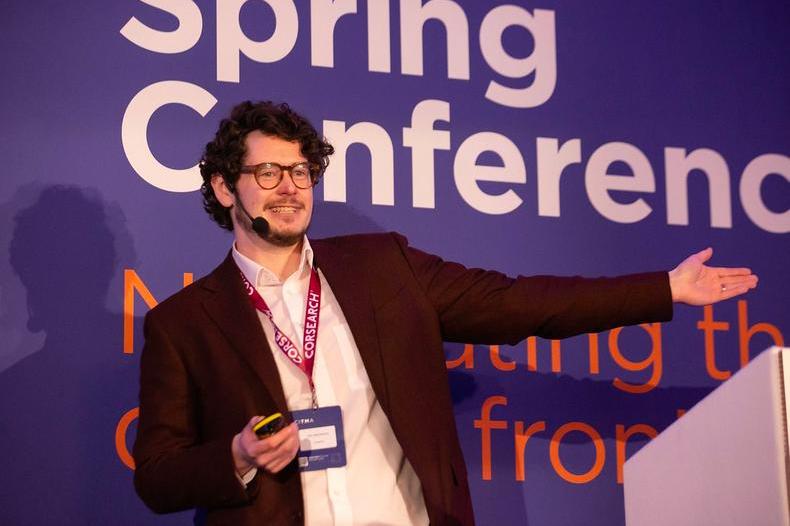
At the CITMA Spring Conference 2026, Corsearch will explore how hybrid intelligence is reshaping modern trade mark workflows, with a practical focus on how AI-driven risk intelligence and human expertise are being combined by leading practitioners to deliver faster and more confident clearance and protection.
As part of the programme, Corsearch will invite attendees to take part in the AI vs Human Challenge, a seven-day, side-by-side trade mark search experiment designed to demonstrate how modern, legal-grade AI compares with traditional approaches in real-world clearance scenarios.
The challenge offers trade mark professionals an opportunity to experience firsthand how next-generation risk intelligence is changing how clearance, screening, and enforcement decisions are made.