

Before you launch: four branding checks every food and drink business should make
What can we learn from the recent Supreme Court ruling with plant-based brand, Oatly? Chartered Trade Mark Attorney, Craig Beaumont dives into the key takeaways.
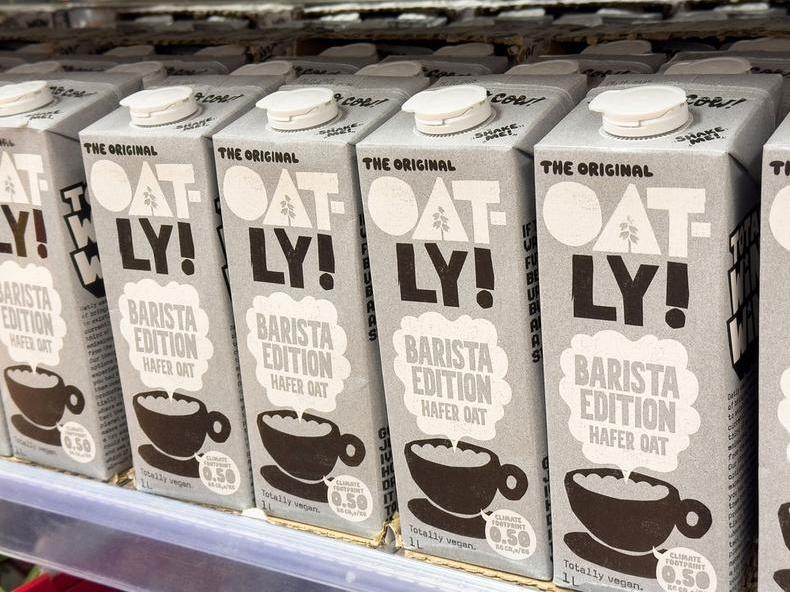
Me: “Can I have a flat white with oat drink?”
Barista: “You mean oat milk?”
Me: “That’s illegal.”
Earlier this year, the UK Supreme Court confirmed that Oatly’s slogan POST MILK GENERATION could not remain registered as a trade mark for plant‑based food and drink products. The decision was not about consumer confusion, or whether anyone believed oat drinks contained dairy. It turned on a narrower point: under UK law, milk is a protected term.
The Court held that those rules do not just apply to ingredient lists or product names. They apply to branding more generally, including trade marks. If using a mark would breach product‑designation rules, trade mark law will not step in to protect it.
With that in mind, here are four checks worth making before launching a new food or drink brand.
1. Are you using a protected term?

Some words come with legal baggage. In food and drink, that includes terms that carry specific legal meaning or restrictions, including milk, cheese, butter, yoghurt, wine, and olive oil, as well as organic and protected origin names such as Protected Geographical Indications (PGIs) and Protected Designations of Origin (PDOs), including Parma Ham, Feta and Champagne.
If a word describes a regulated product category, carries a legal definition, or has historically been restricted to certain producers, ingredients or methods of production, it should be treated as a protected term unless and until you know otherwise.
The Oatly decision shows that the risk is not confined to describing your product as one of those things. Referring to a protected term in a brand name or slogan, in relation to goods that do not qualify for it, may already be enough to cause a problem.
2. What does the branding imply?
In regulated markets, implication can be risky. As the Oatly decision illustrates, it did not matter that consumers would understand what the branding was intended to convey. The legal test was whether the mark used a protected designation in a way the regulations did not allow.
At the same time, branding that implies characteristics a product does not have can create risk under misleading advertising rules, where consumer perception is central.
Problems often arise from the combined effect of the name, packaging and messaging. A brand that sits close to the regulatory line, backed up by packaging that pushes the same idea, is more likely to attract attention.
A useful early sense‑check is to ask what characteristic the branding points towards.
3. Have you cleared more than just the trade mark register?

Most brand clearance exercises focus on whether there are earlier trade marks that could block registration. That is essential, but it is not enough.
A mark can be distinctive, available and even registered, and still be vulnerable if its use would be unlawful under another legal regime. That is exactly what happened here.
For food and drink brands, trade mark clearance needs to sit alongside regulatory sense‑checking. The real question is not just “can we register this?”, but “can we safely use and protect it?”.
4. Have you registered and cleared the brand before investing in it?
Registering a trade mark is not just a formality. It is how you secure exclusive rights in a name you are about to invest in.
That makes early clearance essential. Before committing to packaging, labelling or a product launch, you should be confident the name does not infringe existing rights and can actually be protected. Discovering a problem after labels have been printed or recognition has been built is an expensive way to find out.
Registration also needs to reflect commercial reality. A broad specification can look attractive, but it is of limited value if parts of it cannot be enforced. In many cases, a registration that matches what you can lawfully sell, and how you plan to use the brand, is far more useful.
The Oatly decision is a reminder that there is a difference between using a brand and being able to protect it. A mark can be used for years and yet its use and registration can still be subject to challenge.
Conclusion and key takeaways

It is worth being clear about what the Oatly case was, and what it was not. No regulator took action against Oatly. There was no enforcement notice and no official ban on use of the slogan. The issue arose because a trade association chose to challenge the trade mark itself, not because of regulatory enforcement.
The decision also reflects wider scrutiny of plant‑based branding, particularly in the EU, where naming conventions such as ‘burger’, ‘sausage’ and ‘steak’ continue to be contested. Consumer understanding is not the legal test.
The takeaway is not that creativity should be avoided. It is that creativity needs to be grounded in regulatory reality. For food and drink brands, early clearance, realistic registration strategies and an understanding of the wider regulatory landscape are often what determine whether a brand holds up or must be revisited later.
Author
-

Craig Beaumont
Trade Mark Attorney, Barker Brettell LLP