

CITMA Spring Conference 2026: Key talking points
This year’s conference saw more than 180 delegates, speakers, and exhibitors come together in London for a day of learning and building new connections.
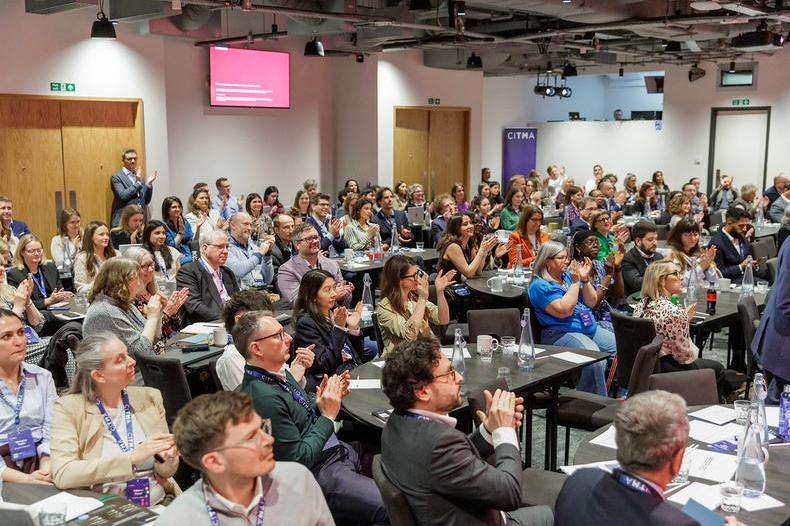
Our Spring Party festivities began the night before at the iconic Sea Containers London, where delegates were able to enjoy the stunning views overlooking the Thames – a memorable start to the day ahead.
Thank you to Corsearch for their continued support in sponsoring this event. Below, we explore the key talking points from the day's sessions.
EUIPO will stay human-centric

João Negrão, Executive Director of the EU Intellectual Property Office (EUIPO), provided the keynote address to open our Spring Conference.
João shared the EUIPO’s commitment to remain human-centric, implementing AI in a way that is transparent.
He told delegates: "At the EUIPO, I have to say that we view AI with a blend of ambition and responsibility. We recognise its power to improve services, increase efficiency, and enable faster, more predictable decision making. However, we are committed to implementing AI in a way that is transparent and above all human centric."
He went on to confirm that final legal and administrative decisions at the EUIPO will always be made by a human.
2025 was a “extraordinary year” for the EUIPO, with record filing volumes, the 5 millionth trade mark filed, and the launch of new long-term initiatives.
João remarked that “despite the geopolitical uncertainty in which we all live, the trust that the global business community places still in the IP system and in this case also in the EUIPO remains steadfast.”
UK case law update

Sarah Talland from Potter Clarkson offered a comprehensive update on significant UK case developments from the past year.
A highlight of the discussion was the emerging influence of generative AI. The Prohealth Solutions Ltd v Prohealth Inc case highlights the significant risks of using generative AI in legal proceedings, as an applicant’s reliance on ChatGPT led to "hallucinations" including fabricated case names and invented quotes presented as real authority.
Sarah explained that the case, “really makes a distinction between honest mistakes and misunderstandings and the more serious issue of relying on fabrication cases.”
Adding that, “a key quote to come out of the decision was, ‘advocates should always be prepared to explain to a court or tribunal what they've included in their skeleton or other written arguments’.”
The decision prompted the UK IPO to include formal warnings in its official letters, advising parties of the severe consequences of failing to rigorously verify AI-generated submissions.
In contrast, the Getty Images v Stability AI case examines the legality of AI outputs themselves, specifically where the "Stable Diffusion" model replicated Getty’s watermarks in generated images. Sarah highlighted some key considerations around the nature of AI prompts, ‘How was the watermark appearing and who put it there?’
The recommendation: brand owners should continue watermarking their digital content, as this provides essential evidence if their assets are used to train AI models without consent.
IP in the Supreme Court
Douglas Campbell KC of 3 New Square explored IP in the Supreme Court, highlighting key trends across recent cases. He noted the Supreme Court’s high regard for first-instance decisions, saying: "They do take the first instance very seriously particularly if there's a split".
In Iconix v. Dream Pairs, the Supreme Court restored the trial judge’s finding of no infringement. While the Court confirmed that post-sale confusion can be a self-standing basis for infringement, it emphasised that appellate courts should be cautious when overturning a trial judge's factual multi-factorial evaluation.
In the Dairy UK v Oatly AB case the Court held that the mark "Post Milk Generation" was prohibited because it used the word "milk" to designate a non-dairy product, and did not fall under the "descriptive" exception.
Campbell warned practitioners to "expect the unexpected because the fact that no one's argued a point to the Supreme Court doesn't mean they're not going to run with it anyway".
The future of trade mark workflows
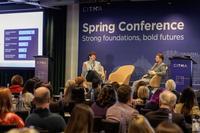
Trade mark practice is evolving fast, and the next generation of AI is transforming how legal teams work. Stephen Lowry from Brandsmiths and Colm MacSweeny from Corsearch took to the stage to explore how artificial intelligence is being practically embedded into trade mark workflows, and what that means for firms, clients and the profession as a whole.
Both speakers championed the concept of "assisted intelligence", using AI to handle repetitive, time-consuming tasks such as searching, drafting correspondence and portfolio organisation, while keeping a human firmly in the loop to verify outputs and apply legal judgment.
Stephen told delegates, “The key thing when we're looking at AI and workflows is to make sure that we're not sacrificing quality whenever we're thinking about scaling, and that we’re not moving too fast. That old saying, you know ‘act in haste repent at leisure’. I really do believe that.”
The session also tackled the risks that come with increased AI adoption, from lawyers inadvertently relying on fabricated case citations to the growing use of AI by infringers, including the unauthorised digital impersonation of celebrities.
On the commercial side, Stephen and Colm acknowledged the tension between client expectations of cost savings and the significant upfront investment firms must make in AI platforms. Both agreed that the path forward lies in incremental, thoughtful adoption – and that education will be critical, not just for the next generation of lawyers, but for experienced practitioners and clients alike.
Life in the Law: Turning insight into action
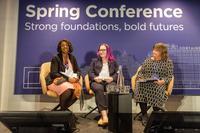
Elizabeth Rimmer from LawCare, Doris Akufo-Addo, Lewis Silkin and Kay Szawlis, Springbird IP discussed mental health.
The trio said that mental health should be seen as a daily reality rather than an extraordinary issue. They encouraged managers in the profession to build genuine connections with their staff – as Kay pointed out, whether remotely or in-person, your colleagues are often the people you spend most time with and those relationships are vital. Kay added: “If they can't pick up on a vibe that I'm in a certain mood, then are we really connected?”
Doris drew on her experience volunteering with the Samaritans – active listening can be incredibly powerful and supportive the panel concluded.
Elizabeth Rimmer from the charity LawCare had earlier set the scene with findings from LawCare’s recent research. “60% of people working in the legal profession are struggling with their mental health, about 50% experience anxiety, high risk of burnout, bullying or harassment,” she said.
Rice, Rice, Baby: Reviewing the impact of key CJEU decisions
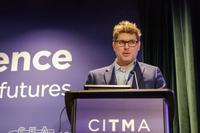
Next up, Allister McManus from Elkington & Fife delved into some of the major post-Brexit issues facing UK Chartered Trade Mark Attorneys today. Speaking with two of his own General Court appeals in the balance, he walked delegates through the trio of cases that have defined this area – ‘BASMATI’, ‘NOWHERE’ and ‘SHOPIFY’.
The headline development was the CJEU's February 2026 judgment in NOWHERE (“Ape Tees”), which confirmed that earlier rights relied upon in opposition proceedings must continue to exist until the moment EUIPO gives its final decision (decision of BoA if appealed).
He added: “If the final BoA decision is after the transition period an earlier UK right relied on under Art 8(4) ceases to be legally relevant for EU opposition proceedings, even though the right continues to exist in UK law & existed in the transition period.”
Allister had three main criticisms of the Ape Tees case:
- It's a register conflict – oppositions are about who was first, not infringement actions, and the CJEU’s purposive approach shouldn’t end up with unfair result.
- The Withdrawal Agreement never addressed it – the reliance on Budvar, an invalidity case with retroactive effect, doesn’t make sense in a Brexit context where the UK rights genuinely existed during the transition period.
- It opens a can of worms – confirming two or more dates to meet is a huge burden on all opponents, not just UK owners, with no clear logic as to how evidence of reputation can realistically be maintained across both dates.
With the SHOPIFY appeal still pending, he noted that important questions around registered EUTMs and reputation evidence under Article 8(5) remain unresolved – and potentially offer a lifeline for those, like himself, with live appeals before the General Court.
Disclosure in IP litigation
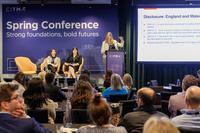
Baker McKenzie trio Kerri Ann Hazzard, Carinne Kamdar and Rachel Wilkinson-Duffy provided delegates with a comprehensive guide to disclosure within the context of UK intellectual property litigation.
The in-depth practical session provided delegates with an overview of the disclosure regimes in England and Wales.
They provided practical tips for managing disclosure in IP litigation.
On pre-action strategies, they said: "What I would say is just get some early advice and check in with the teams on which forum is probably most advantageous based on what the client is trying to achieve. So, if they have budget constraints we're looking at IPEC - there's the cost cap there we're going to make sure that disclosure is quite specific and that you know costs don't become unwieldy."
Once litigation commences, they suggested: "You have to wear a project management hat even more so than your lawyer's cap. And that is because there are so many deadlines, so many codependent deadlines. And it's really important to check that you have scoped it properly, you've got capacity in the team... because the pace at which things ramp up as soon as the litigation timeline commences is frightening."
And as a general point: "Keep decision logs. This is so important from a defensibility perspective. So you may need to justify to the court or to the other side why you made all the decisions you did... It's important for consistency if new people are added to the team... So, it's a bit of future-proofing and combating against risk exposure."
The future of lookalikes post-Thatchers
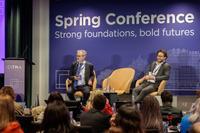
To round off the talks for the day, Geoff Steward from Addleshaw Goddard and Bence Bozóki from Mars delivered an engaging discussion on lookalike products. They opened by setting the commercial scene, reporting that as of 2024, private label brands accounted for 39% of the European market share, and, according to a study carried out in the EU, UK and the U.S., 54% of respondents said they primarily or (almost) exclusively buy private label products.
Against this backdrop, the session explored why lookalikes remain such a persistent threat to brand owners. Drawing on consumer psychology and the concept of "system one thinking”, Geoff explained how a supermarket is a hyper-stimulating environment, leading shoppers to typically navigate shelves not by reading names, but by instinctively recognising the colour, shape, and artwork of a product.
The centrepiece of the session was the Court of Appeal's decision in Thatchers v Aldi, which Geoff declared to be “the only authority needed for trade mark infringement on lookalikes.” The court found that Aldi's cloudy lemon cider packaging constituted trade mark infringement through unfair advantage, without any need to prove consumer confusion. Geoff stated, “Arguably, lookalikes are taking unfair advantage of everyone’s human brain. They’re using these heuristics to lure you in.”
Bence had clear, practical takeaways for brand owners: invest in unique and distinctive assets and use them consistently. He also advised delegates to monitor infringement proactively and use unfair advantage as the primary cause of action, as this will lead to success if you have the right registrations in place.
View photo gallery