

EUIPO will continue to be human-centric says EUIPO Executive Director
The EUIPO leads its development of AI with "ambition and responsibility" but the final decision in any process will remain a human one, João Negrão, Executive Director of the EU Intellectual Property Office told our Spring Conference delegates.
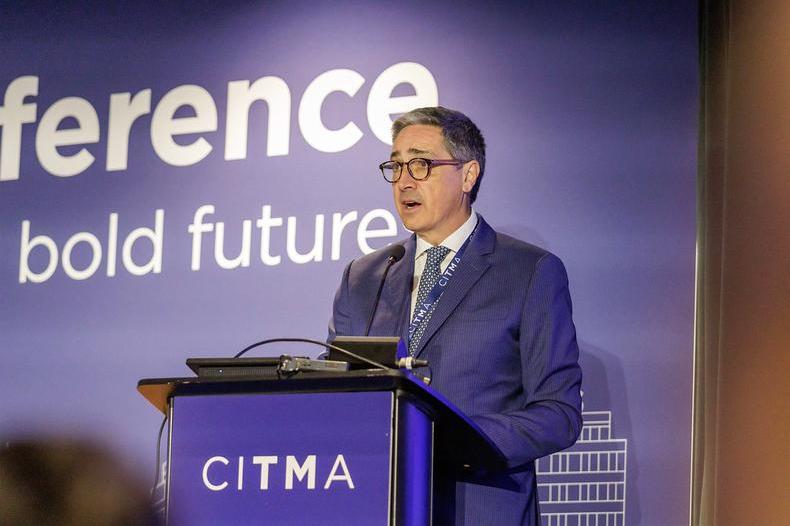
João Negrão, Executive Director of the EU Intellectual Property Office, delivered the keynote address at CITMA's Spring Conference 2026.
AI: ambition and responsibility
Artificial intelligence featured prominently, as it does in almost every IP conversation at present. The EUIPO currently runs several AI-powered services, with more in development. Negrão described the office's approach as one of "ambition and responsibility" - embracing AI's capacity to improve efficiency and predictability while ensuring that the final decision in any process remains a human one.
He drew particular attention to the EUIPO's early trade mark screening tool, launched in November 2025, which allows users to identify potential issues before filing.
The office has also published a report on generative AI and copyright, assessing the legal uncertainties and emerging tensions in that space - a resource that may be of value to members advising rights holders or AI developers navigating an unsettled landscape.
A record-breaking year
Mr Negrão had begun his keynote address with some impressive statistics. In 2025, the EUIPO received a record-breaking 327,000 new applications - a 7.8% increase over the previous year, driven by a 9% rise in trade mark filings and a 6% increase in design applications. The office also reached its five millionth application, a remarkable milestone for an institution that opened its doors in Alicante just 30 years ago, João told delegates.
UK-based trade mark applications at the EUIPO rose by 5% in 2025, while EU design applications from UK filers saw a striking 18% increase compared with 2024. The UK remains the seventh largest filer across both EU trade marks and designs.
A partnership that goes back to the beginning
Negrão acknowledgement CITMA's role in shaping the EUIPO's work. He noted that in 2025 alone, the office engaged in nearly 200,000 interactions with users - the highest figure since operations began - and was clear that user associations like CITMA have been central to that dialogue from day one.
"Your insights have remained a constant," he told delegates. "Whether through CITMA's role as a rotating member in our Management Board and Budget Committee meetings, your participation in our user groups and focus groups, or your engagement with our cooperation virtual communities - you ensure that what we build reflects the real needs of users."
That relationship extended to the EUIPO's current strategic framework. CITMA's input fed directly into the Strategic Plan 2030, published in January 2025, and Negrão was explicit in his thanks for that contribution.
Expanding the mandate
Beyond the headline filing figures, 2025 was also a year in which the EUIPO took on significant new responsibilities. In May, the design reform entered into force, aligning design protection with the digital realities of the 21st century. In November, the office launched its Copyright Knowledge Centre. And in December, a new system for crafts and industrial geographical indications provided EU-wide protection for traditional craftsmanship.
Each of these developments reflects an office that is consciously broadening its scope — moving from a registration body to something closer to a full-spectrum IP authority. For practitioners advising clients across the IP landscape, that shift has practical implications.
Fit for the future?
"We must ask ourselves a difficult - perhaps even uncomfortable - question," he said. "Is the intellectual property framework designed for the industrial age now confronted with an economy that is powered by algorithms, driven by data and interconnected through global digital networks?"
He offered several specific examples to sharpen the point. On trade mark term lengths, he noted that EUIPO research shows half of all EU trade marks do not survive past year five - raising the question of whether the standard 10-year registration cycle serves modern businesses, particularly entrepreneurs, as well as it should.
From protection to leverage
"The time has come to move beyond viewing intellectual property solely as a tool for protection," he said. "IP should not simply shield innovation. It should enable growth, attract investment, facilitate partnerships, and unlock new markets."
The practical initiatives he described in support of this shift included a new IP valuation methodology, due to be delivered in 2027, developed in partnership with financial institutions across Europe. The aim is to allow innovative businesses to use their intangible assets to access financing - addressing what Negrão described as a persistent failure of the financial framework to recognise the true value of IP rights.
He also highlighted the EUIPO's SME Fund, which has already supported over 100,000 businesses in protecting and managing their IP, and pointed to the expansion of the office's mediation services to cover all inter partes proceedings, including oppositions, cancellations and appeals.
Looking ahead
Negrão closed with a call for continued collaboration, framing events like our Spring Conference as essential spaces for the kind of wide-ranging, forward-looking discussion the IP community needs. His parting thought was characteristic of the speech as a whole: honest about the scale of the challenge, but optimistic about the capacity of the system, and those who work within it, to adapt.