

The vision and drive behind this year’s Sheila Lesley winner
At this year’s Christmas Lunch, we proudly announced Azhar Sadique as the winner of the Sheila Lesley Volunteer of the Year Award.
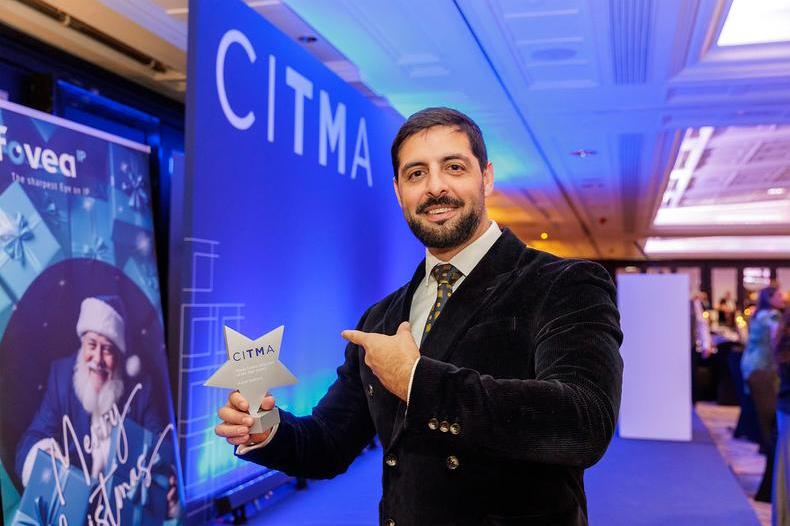
The prestigious award recognises members who sit on a committee, steering group, taskforce or working group and have made a significant impact through their contributions over the past 12 months. We caught up with Azhar to learn more about his career journey and the ambitions driving his next steps.
A worthy winner
The award judges noted Azhar’s continuous engagement with, and commitment to, the profession, as well as his thought leadership through his “transformative” work as Chair of the CITMA AI and Technology Committee.
Earlier in the year we published a new report exploring AI’s impact on the profession, including both the opportunities and challenges that come with the introduction of new technologies. Steered by the CITMA AI Task Force (now the CITMA AI and Technology Committee) with Azhar at the helm, this has become an invaluable piece of work, providing essential support and guidance to the industry.
In reference to the report, one judge commented, “This is exactly what our profession needs to show we are ahead of the curve.”
Azhar is keen to share his accolade with fellow committee and task force members, stating that he “definitely wouldn’t” have got this award if it wasn’t for them, “This is recognition for everybody who's worked on that [AI report] and everybody who's contributed from an AI point of view over the years.”
When the IP penny dropped
However, a career in intellectual property (IP) wasn’t always top of Azhar’s list. In fact, he was set on a very different path until his mum intervened, “I was planning on going down the engineering route and I was actually on my way into the army, having completed my first stint. Then my mum decided to enrol me on a law course that she’d seen via a clearing space in the newspaper.”
Following this, Azhar went on to study law at university. But it wasn’t until his final six months, when undertaking a module on IP, that the “penny dropped”.
Having grown up around various family businesses, from selling furniture on market stalls to cold calling antique companies and even starting and selling a mobile car valeting service with his brother at 14, Azhar describes himself as very “business minded”. It was this upbringing that led him to want to be involved in advising and shaping business decisions, and he realised IP plays a central role to this.
Azhar explains, “What I love to do is find difficult points of feedback for brands or difficult hold-up points for businesses and law firms, and then try to create solutions to make them more workable. For me, it’s always about efficiency and growing and is why I enjoy the Advisory Boards so much as they serve whole segments of industries, not just sole firms or businesses.”
Now as a Chartered Trade Mark Attorney, Founding Partner at Abion, and Chair on various Boards/Committees, he’s quick to add, “In the end it turned out to be a wise choice for my mum to pick law out of the newspaper, maybe it was fate.”
Supporting the industry in a new age
Azhar also credits important figures who have supported him throughout his career. One of his earliest influences was Roy Scott, a Senior Paralegal at Keltie LLP, who played a key role in the development of the CITMA Paralegal Course.
“I think I was lucky to always have people around me that acted as my mentors, whether it was directly or indirectly. I also think it is crucial that professionals, at any stage in their career, from new entrant to CEOs always have a trusted mentor they can turn to.
He adds, “It helps validate and ground decisions on good reasoning, whilst encouraging honest feedback and personal growth that can often be lost when things get busy.”
With the pace at which technology is evolving, Azhar believes mentorship will become even more crucial, “Law firms have targets they need to meet to be sustainable, often they are unrealistic or unachievable – the only way to change this is by flipping that model to remove this burnout angle,” he continues, “and that will be helped by AI. But it will also be helped by educating individuals on how to be more actively productive.
“You cannot bill 14 hours in an 8-hour working day and burnout should categorically not be made a badge of honour or requirement for progression. Those sorts of approaches need to be phased out.”
For Azhar, this is the most important aspect of the committee’s work: supporting new entrants to train differently, with technology at their side.
Collaboration is key for the future
Looking ahead, Azhar identifies three core goals for the AI and Technology Committee:
- Establish good, safe and ethical use of AI across the profession
- Support the industry in operating differently
- Educate professionals in growing their careers and becoming technology fluent
While acknowledging there’s a lot of work to be done, Azhar is calling on all of the industry to work together to achieve these goals, “We have to be so different now, and that means being open and collaborative, and there to support others. That has been a huge benefit of the Committee. Lots of opinions from competing firms, client organisations, in-house teams, Government officials, regulatory advisors – all coming together to share how we take full advantage of this time we find ourselves in.”
“We have an opportunity to help each other from a personal and professional point of view by being more open. We don't do it enough, and most other industries do, so we can't expect to get to that level by remaining as closed books.”
Much of this aligns with what he describes as his “passion project”, focused on improving mentoring, psychological welfare, and future proofing training across the industry. He envisions a platform that helps professionals grow, reflect, and connect in an increasingly digital landscape.
As AI becomes more embedded in daily practice, Azhar believes dedicated time for reflection and connection with others will become indispensable to offer “real” advice that cannot be replicated by AI.
“As we turn the dials up on how we offer services, we're also going to turn the dials up on how everybody feels about themselves in those moments… whether they're feeling overwhelmed or whether it's even possible to do what they’re trying to achieve.
As our conversation draws to a close, Azhar takes the chance to share a final thought and with a look of determination, he tells me, “I'm really thankful for the award, but it's not the end point. It's sort of like a mandate to push harder now and see where we can really go with this… and be transformative.”
Find out more about the Sheila Lesley Volunteer of the Year Award.