

CITMA Paralegal Conference 2026: Key talking points
This year's conference saw more than 140 paralegals, speakers and exhibitors packed into the Grand Connaught Rooms in London for a day of learning and building new connections.
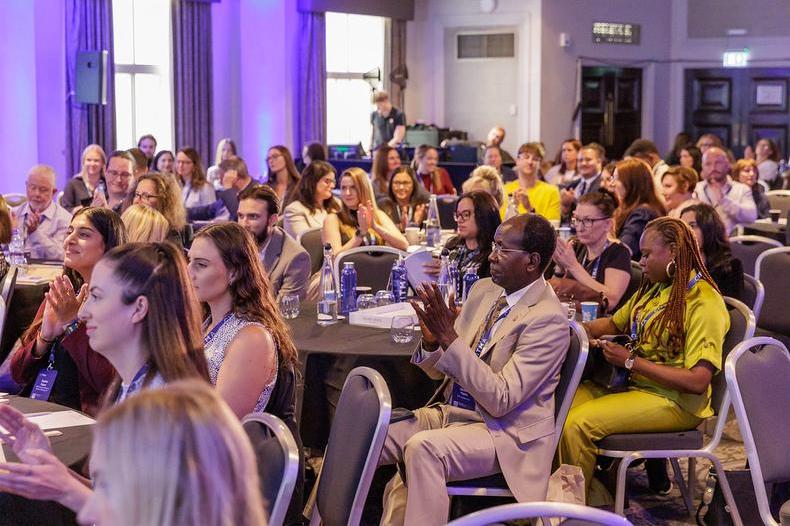
Thank you to all our speakers and WebTMS for sponsoring the event. This article explores some of the key talking points from the day’s sessions.
Evidence to stop a trade mark becoming generic
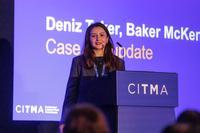
Deniz Toker, a Chartered Trade Mark Attorney at Baker McKenzie, provided important insight on four recent key cases.
Stopping a brand becoming generic was the central point in the Dryrobe v Caesr Group case. Deniz told delegates that Dryrobe had systematically and consistently taken steps to gather evidence on the term Dryrobe being used as a designation of origin – and had done so proactively for some time.
It has monitored social media for the term Dryrobe, writing to users encouraging them to use the term ‘changing robe’ when not referring to a Dryrobe product. “Evidence showing how consumers actually use a term can be a decisive factor,” said Deniz.
Delegates were also given key points from cases involving Oatly, Tesla and Lifestyle Equities.
Transformation and cessation of effects
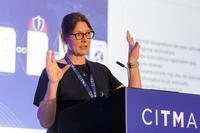
Lucy Walker, a Chartered Trade Mark Attorney at Barker Brettell who started out as a paralegal, took delegates through two of the highest-risk areas of Madrid System practice, transformation and cessation of effects.
Lucy highlighted the importance of this area for paralegals, stating that they serve as the primary line of defence by actively monitoring base mark disputes, tracking strict deadlines, and obtaining early client instructions.
While international registrations offer a streamlined path to global protection, they remain inherently vulnerable during their first five years because their survival is strictly tied to the base mark.
This led Lucy to talk through the chain reaction of cessation, from losing your mark, to notifying the World Intellectual Property Office (WIPO), and the impact on your designations as a result.
Lucy explains, when you lose a base mark, transformation acts as an essential rescue mechanism, “Transformation was introduced as a safety net to prevent a single successful attack from wiping out protection worldwide.”
It enables brand owners to convert affected international designations into national applications, while preserving their original filing, priority, and seniority dates.
She stated, “The key question for you as paralegals is if you see something that's happened to your base mark, ask yourself, ‘does that international registration still rely on the base mark?’”
A key take home was that transformation is subject to a very strict time limit. You have a three-month window from when WIPO inform you that a mark is lost to register your filings. It cannot be extended, miss it, and the option is gone.
How AI and technology is changing paralegal roles
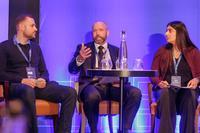
Our technology panel of Sophia Kaur (CMS), Nick March (Alt Legal) and Tim Elgar (Formula 1) – chaired by Kane Ridley (Alt Legal) shared their thoughts on how paralegal roles are changing.
Sophia Kapur, a senior trade mark paralegal at CMS pointed out that AI “does not have the substantive IP knowledge we do - so I would be uncomfortable with it just giving opinions and then sending that to the client.”
“I just wouldn't use AI for any work that I can't independently verify where it got its facts from,” said Sophia.
Over the past five years Nick remarked that “teams want to do more with their data”. There has been a lot of emphasis on getting platforms communicating, using data feeds with less manual input.
Sophia added that AI is helping gather resources to build first drafts. But reminded delegates that everything still needs to be verified and checked.
The panel agreed that new technology can help free up time, which can be used to help look at processes and other areas.
“From in-house perspective once you free up time, and can focus more time on the brand and how to take things forward”, said Tim.
“It is on us to know when to use AI and when not to,” Sophia said.
“You’re handling highly confidential information. I don’t think your clients would be happy if you were just to put that in like a web version of some sort of AI and then leak all their secrets,” she added.
Nick added that we are going to be spending less time inputting data and more time reviewing it. It is always important to keep human in the loop.
The role of paralegals: private practice and in-house
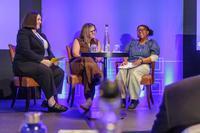
This panel brought together Mellissa Thornton from Barker Brettell and Ruth Bryan from Stobbs IP to discuss the trade mark paralegal role from private practice and in-house perspectives.
Both speakers reflected on how they "fell into" IP, with Mellissa joining as the firm’s receptionist in 2018, while Ruth’s career in trade marks began more than 30 years ago.
A central theme was how much the role has evolved: paralegals in private practice now have billing targets, and the CITMA paralegal course, CPD and competency framework have brought formal recognition to a role that was once largely administrative and process driven.
Mellissa added, “Five years on, looking at the role of the paralegal, there’s so much more scope. There’s a lot more variance – all three of us here have the title Trade Mark Paralegal, but our day-to-day lives are so different.”
In-house, the emphasis is different – closer involvement with stakeholders and commercial decision-making.
On confidence and credibility, the pair agreed that qualifications matter but aren't the whole story. Passing the CITMA Paralegal Course, brought Mellissa validation to say, “I know what I’m talking about”, but she was also keen to stress the importance of support from people around her, “If you’ve got good training, if you’ve got good mentors, I think that can really help instil confidence in you.”
For Ruth, real confidence came from day-to-day exposure to licensing, brands, marketing, finance and those practical experiences, “You did the job, you got positive feedback.”
The session closed on career advice, as Ruth encouraged embracing detours, “I wish that somebody had told me your career is a journey. You've got highs, lows, you've got
detours. Just remember, it's a journey.”
While Melissa urged newer paralegals to “take a leap of faith”, ask questions, and not to fear mistakes.
Work on IPO’s new trade mark service has begun
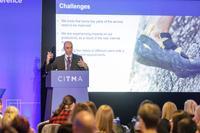
The UK IPO’s Simeon Bowen confirmed to delegates that work has begun on the IPO’s digital transformation for trade marks.
The work is in its infancy though, with the government body currently in the ‘discovery phase’ where they are conducting user research. Simeon asked delegates to get involved with the user testing as the project progresses.
The UK IPO’s goal is to provide a modern digital service where customers have a greater control over their rights through digital self-service.
The patents service is already live and to date has seen 30,000 transactions. The system has seen 9,000 users from 1,500 organisations
Simeon gave an early estimate that the trade marks service will launch in 2029.
The biggest challenge for the trade marks service, Simeon said, will be the scale and volume of the data for trade marks.
UK designs reform – major changes ahead?
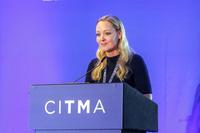
Rosanna Morello Carrieri from Stobbs gave delegates an overview of the UK's proposed designs reform, tracing the process from a 2022 call for views through to the September 2025 consultation, with a response from the UK IPO expected later this year.
Rosanna acknowledged it can be confusing to navigate the current system, with reform aimed at improving the validity of registered designs, simplifying the wider regime, and addressing emerging technologies.
The talk covered eight categories of proposals, starting with search and examination. Rosanna noted that the UK does not currently examine designs substantively, and there is no opposition procedure either. However, she highlights that the current process is very quick compared to other territories, and relatively cheap too.
Proposals for this category included an Australian-style two-stage system, requiring certification in order to enforce the design, but Rosanna commented, “this would slow down the process and increase costs,” adding, “there's a bit of a question of if it really enhances certainty because we have quite a developed unregistered designs regime, which Australia doesn't have.”
Rosanna also covered the uncertainty around protecting graphical user interfaces and animated designs, welcoming the UK IPO's updated filing guidance from earlier this year. In terms of improvements, she discussed possible options such as video file formats to represent an animated design, as well as additional descriptions allowing applicants to clarify exactly what their design is.
The session came to a close by returning to the opening question, ‘are there major changes ahead?’ “There might be. We don't know quite yet... but what is discussed are really, really substantial changes, much more than we have seen in the EU and recent reform.”
Protecting domains
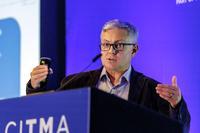
Mike Davies from Abion told delegates that, “protecting brands today means managing both opportunity and risk: a clear domain strategy, strong digital trust controls, and continuous monitoring of emerging threats.”
AI is presenting new opportunities in the domain space, but also new threats. AI is making online abuse faster, cheaper and more convincing, Mike warned.
These AI threats are coming from more sophisticated brand impersonation, including AI phishing – where it is much easier to mimic a brand using AI than it was before. Some of the tell-tale signs of a phishing scam, such as typos and wonky logos, are no longer present thanks to the scammers’ access to AI.
Mike suggested that we should be prioritising where customers want to see you and where there's risk, rather than just buying more domains.
Update from our paralegal representatives
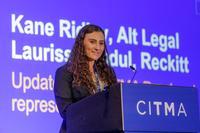
Kane Ridley from Alt Legal spoke fondly of entering his fourth term as CITMA Paralegal Representative and the ways the community has expanded during that time. He welcomed Laurissa Abdul to the stage, who was recently appointed as CITMA Vice Paralegal Representative.
With 657 CITMA Paralegal members and 87 new joiners in the past year, Laurissa was also keen to celebrate the community’s growth, commenting that the conference continues to grow year on year and its success is reflected “not only in the number of attendees but also in the calibre of speakers we are fortunate enough to welcome.”
Speaking about the membership, she also highlighted a few key benefits, including the CITMA Mentoring Scheme. Laurissa described mentoring as invaluable to career development, “helping individuals build confidence, expand their professional networks and gain insights from those with different experiences within IP.”
Looking ahead, Laurissa flagged 2027 plans to update the Paralegal Competency Framework and explore an advanced paralegal course, noting, “These initiatives will require the support and expertise of volunteers from across our membership. When opportunities arise, invitations will be circulated, and I would strongly encourage you to consider getting involved.”
Updates from WIPO
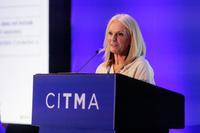
WIPO senior legal officer Lucy Headlington-Horton provided insight and analysis from the World Intellectual Property Organisation (WIPO).
In 2025 WIPO saw a slight decrease in international applications, falling to 64,150. However, the average number of designations per application has increased from 7 to 7.5.
Over the past decade there has been a shift in where applications come from Asia has a strongest growth from 15.5% to 25.6%, but Europe still leads the way at around 50%.